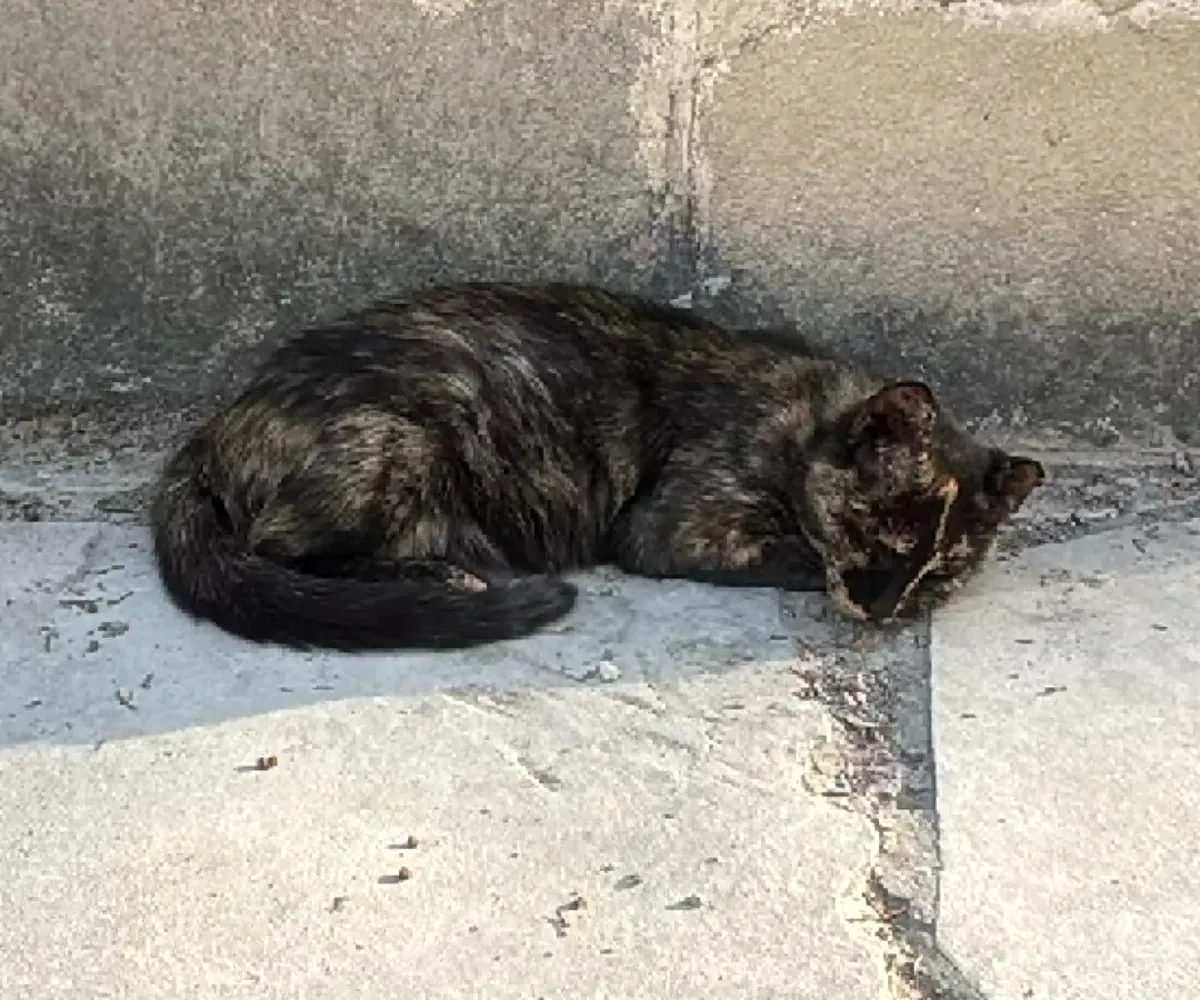
Calico cats are everywhere. They doze on warm car bonnets, guard doorsteps and turn up at every feeding spot. But try to find a calico tom and you could look for years.
That’s not luck. It’s written into where the colour orange sits in a cat’s genes.
In short
| How rare? | About 1 calico in 3,000 is male. |
|---|---|
| Why? | Orange and black need two X chromosomes. Boys usually have one. |
| How does it happen? | Usually an extra X: the cat is XXY. |
| Can they father kittens? | Almost never. |
| Can you tell by looking? | No. Only a vet check can. |
Calico, tortie: what’s the difference?
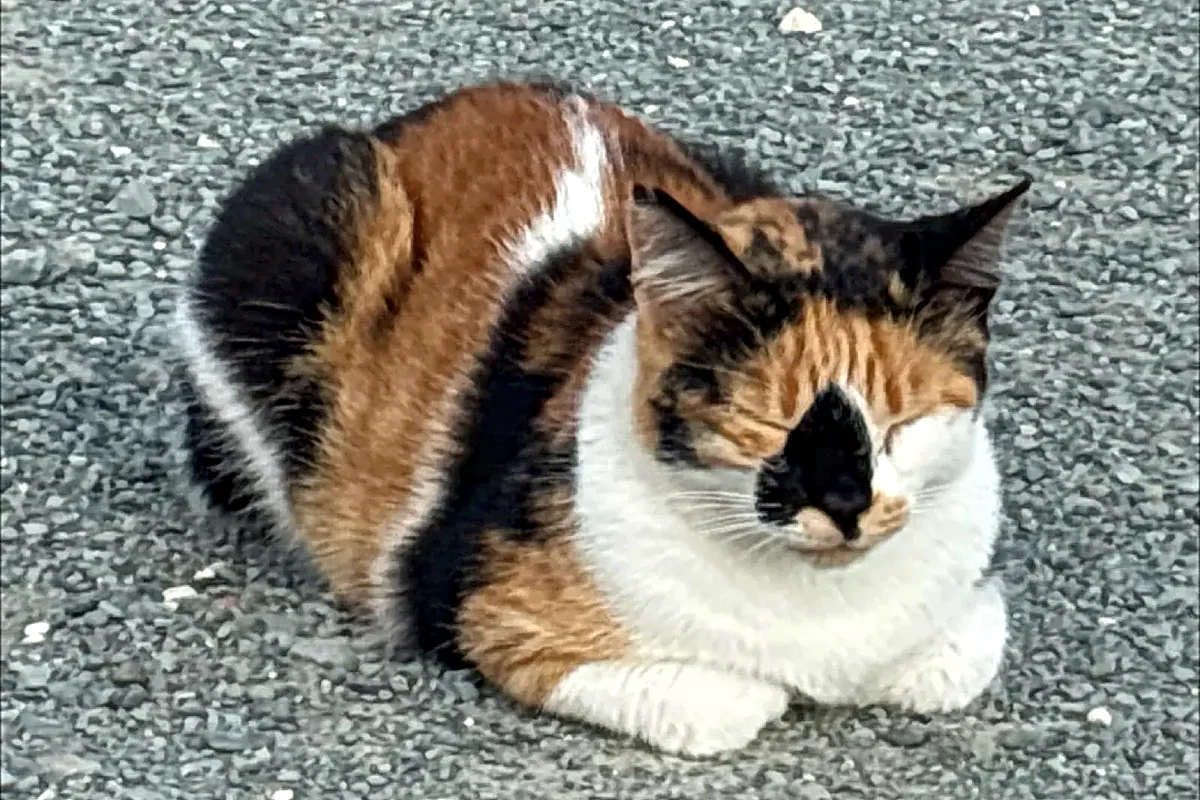
A calico has three colours: patches of orange and black (or their paler versions, cream and grey) on a lot of white. A tortoiseshell, or tortie, has the same orange and black patches, mixed together with little or no white. The white comes from a separate gene, so for this story they’re the same thing. Both are almost always female.
Why orange needs two X chromosomes
Whether a cat’s fur comes out orange or black is decided by a gene on the X chromosome. In 2025, after decades of searching, two teams in Japan and the US finally found it: a small piece of DNA missing near a gene called ARHGAP36. Cats with that change on an X make orange fur. Cats without it make black.
Females have two X chromosomes, so they can carry the orange version on one and the black version on the other. Early on, in each patch of skin, one of the two X’s switches off at random. Where the black one is off, the fur grows orange. Where the orange one is off, it grows black. The result is a patchwork, and no two are alike.
Males normally have one X and one Y. With only one X, a tom is either orange or black, never both. That’s also why most ginger cats are boys: a male needs just one copy of the orange version, while a female needs two.
So how does a male calico happen?
Something has to give him a second X. There are three ways:
- An extra X. The most common: the cat is XXY instead of XY, a condition called Klinefelter syndrome in people. He’s male, but has two X’s to make patches.
- Two cats in one. Very rarely, two embryos fuse early on into one kitten, a chimera, so some of his cells are XX and others are XY.
- A change in some cells. Even more rarely, the colour gene changes in some of his cells after he starts growing.
Only about one calico in 3,000 turns out to be male, a figure from a University of Missouri study.
Can a male calico father kittens?
Almost never. XXY males are sterile, and only about one in 10,000 male calicos and torties can father kittens, usually a chimera. That also means the trait isn’t passed on: you can’t breed male calicos, however much someone might want to.
Being XXY can bring some health problems too, so a male calico is worth a vet check. On the street, though, the advice is the same as for any cat: neutering is still worth it, as it keeps toms out of fights and calmer.
How to tell if you’ve met one
You can’t by looking. A male calico looks just like a female one. The only clue is underneath: a vet can check whether a cat is male, and many street-cat toms are only found out when they’re brought in to be neutered. To know why he’s a calico, a lab has to read his chromosomes.
Every year a few turn up in shelters somewhere, and each one makes the local news. In May 2026, a rescue in Springfield, Missouri, took in its first male calico in 12 years.
Lucky cats
In Japan, calicos are called mike-neko, three-fur cats, and the waving lucky cat figure is often one. Sailors kept calicos on ships to guard against bad luck at sea, and a male calico was the luckiest of all.
So when Japan sent its first expedition to Antarctica in 1956, a male calico kitten went too. He was named Takeshi, after the expedition’s leader, Takeshi Nagata, and spent the winter at Showa Station as the team’s pet. He came home safely and went to live with one of the crew. A week later he slipped out and was never seen again.
In the US they’re sometimes called money cats, and since 2001 the calico has been the state cat of Maryland.
Keep an eye on your calicos
Most calicos on your street are girls. But one in 3,000 isn’t never, and with so many street cats around, there’s probably a male calico living somewhere near you. There’s more on rare colours in the rarest cat coats.
Snap the calicos on your street. You never know which one is the boy.